
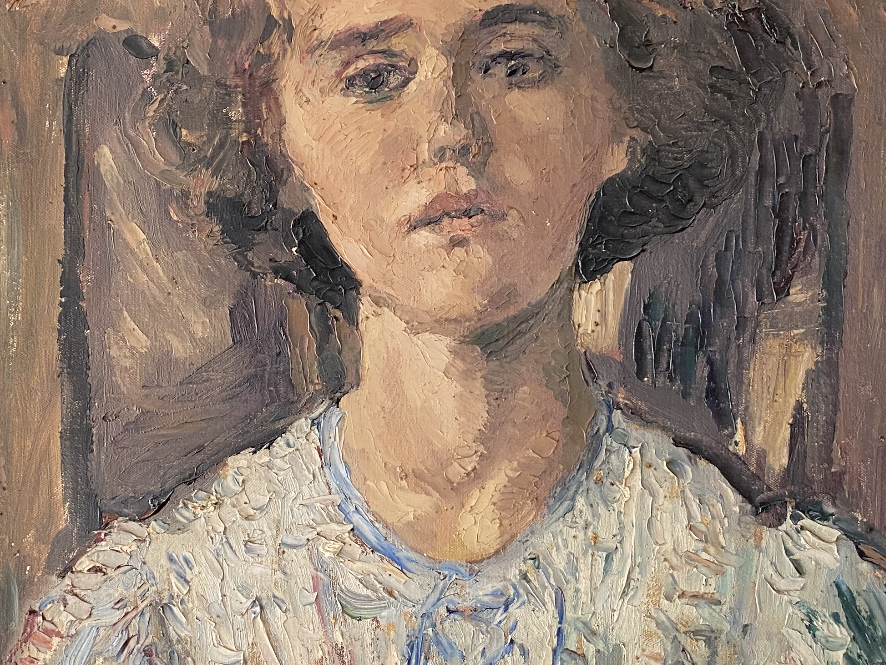
Ronald Ossory Dunlop
Artists
Browse Artworks


Ronald Ossory Dunlop (1894 - 1973)
Biography
Dunlop’s mother was a water colourist and friends of the family included; W.B. Yeats, James Stephens and George Russell. Dunlop was therefore surrounded in early life by seminal figures of the Irish Literary Renaissance.
After his family moved to London Dunlop took a job in advertising, deciding later he wanted to paint and enrolling in the Manchester School of Art and then the Wimbledon School of Art.
As a young man he founded, or in any case joined, the ‘Emotionist Group’ for which he contributed some sort of manifesto.
As he describes in his memoir ‘Struggling with paint’ his breakthrough exhibition at the Redfern Gallery in 1928 provided him with the funds he needed to go to Paris, where he took informal life-drawing classes in Montparnasse and also developed a reverence for both Camille Pissarro and Alfred Sisley. He says of Pissaro ‘Manet might be slick, Monet was clever and large-hearted, but Pissaro was great-hearted, and the most sincere painter I had come across’.
Returning from Paris Dunlop was invited to join The London Group of artists in 1931, quickly becoming a prolific exhibitor at the New English Art Club and the Royal Academy. He would regularly return to Ireland to both paint and show pictures.
Following in the footsteps of early British impressionist Philip Wilson Steer, during the 1930s Dunlop lived at least for part of the time in a caravan behind the beach at Walberswick in Suffolk.
This arrangement left him cramped in the summer, but during low season he took a room at reasonable rates from a local pub and used the caravan as his studio.
From this period, his 1936 painting Lifeboat, Walberswick is now within the collection of the Tate. In the 1940s Dunlop settled in a cottage in Barnham Sussex which would remain his base for the rest of his life.
Style and technique
Dunlop developed a very distinct painting technique, often completing entire paintings using his palette knife to apply paint, wet-into-wet, rather than a brush. As a result his paintings have a rich impasto and feel unusually direct, in some way tangible.
As a professional artist Dunlop had a canny sense of what would make a good saleable commercial picture, often choosing to paint well known stretches of river or popular landmarks. The art critic Frances Spalding described Dunlop as 'an ‘alla prima’ painter of traditional subjects'.
At his height, roughly from the 1930s through to the end of the 1950s, Dunlop really had achieved something that was in some way genuinely original, producing energetic, spirited canvases that were richly impastoed, layer by layer, and by comparison to his peers distinctly his own.
In the 1960s, his final full decade of painting, Dunlop took to painting on bleached white canvases with a broad sable brush. A number of these pictures, especially the portraits, were successful but they feel very different to his earlier work.
Exhibitions
Dunlop was a prolific exhibitor. In addition to frequently showing at the Royal Society Summer exhibition form the 1930s to the 1960s he showed at the New English Art Club, the London Group, the Leicester Galleries, the Royal Glasgow Institute, the Royal Society of British Artists and for his Irish collectors at the Royal Hibernian Academy.
Collections
Dunlop’s work is contained within the collection of the Tate (Lifeboat, Walberswick, Rosalind Iden as Ophelia and a self portrait). Additionally, the National Portrait Gallery, Victoria and Albert Museum, the Crawford Art Gallery in Cork and a great number of other regional museums hold Dunlop’s work.
Market
Dunlop continues to have a primed market of private collectors for his most developed landscapes and portraits Thames Backwater (Trowlock Island) which passed through Bonhams Massachusetts in May 2025 is a magnificent example of what the very best Dunlop looks like and can achieve at auction, making well over ten thousand dollars including premium. The painting is a bravura performance which displays his genius for a perfectly chosen scene, his ability to paint light on water and his distinct use of impasto.
At Skymeadow Gallery
A portrait of a young girl by Ronald Ossory Dunlop that Skymeadow Gallery sold to a long standing client in 2021 (photographed in the header to this page) remains one of the most moving and evocative portraits we have handled at Skymeadow Gallery. Similarly, Dunlop’s river scenes never fail to engage clients when they are on display at the gallery.
We have an unusually large and complete composition on display currently The Thames at Henley with a view to St Mary’s Church
A number of our clients have added Dunlop’s works to their Modern British collections, sometimes even adding new works to join existing works added by previous generations.