
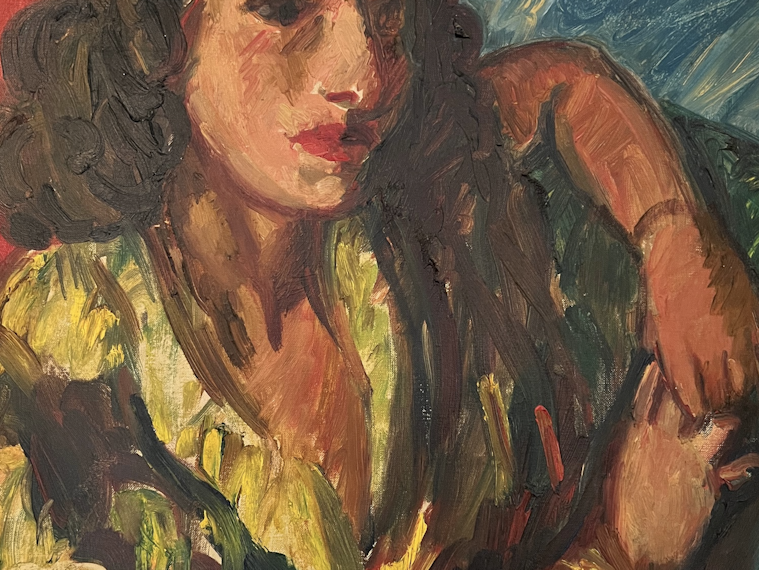
Sir Matthew Smith
Artists


Sir Matthew Smith (1879 - 1959)
Biography
Between 1905 and 1910 Matisse spearheaded a movement known as fauvism which means ‘wild beasts’. Why wild beasts?
The term ‘Wild Beasts’ was coined by the art critic Louis Vauxcelles when he saw their shocking canvases surrounded by classical renaissance-style sculpture at the annual Salon d’Automne in 1905. He thought their paintings looked wild, even violent.
Certainly the fauves work was exuberant, avant-garde and characterised by the bold use of surprising colours. They also prioritised the energetic and physical business of applying paint to canvas, whether with a brush or directly from the tube.
On the other hand, the fauves were celebratory in essence, this was not performative destruction. See ‘The Green Stripe’ also known as ‘Madame Matisse’ a portrait of Matisse’s wife now at the Statens Museum for Kunst in Copenhagen, Denmark, painted in 1905.
Sir Matthew Smith’s path to his pupillage under Matisse did not run in a straight line. He was born into a family of industrialists from Yorkshire in 1879. Despite the industrialism, his home life had a creative edge, his father was a musician and frequently invited musicians to the family home.
Nonetheless the young Smith went to work in the family business. After a few years he made a break for it in 1901 enrolling in the Manchester School of Art. By 1905 he was at the Slade School of Fine Art, he passed through this institution a little before its early twentieth-century golden period (when it contained Stanley Spencer, Dora Carrington, Paul Nash and other astonishingly capable students) though he briefly crossed over with Duncan Grant.
An early trip to France around 1908 is when Smith said his life began. However, it was not until his early thirties, in 1911, that Smith found himself in Paris as a pupil of Henri Matisse.
For most, fauvism was a stepping stone, a transitional moment. In time Derain would fold back into a sort of new classicism. For Georges Braque fauvism was a stepping stone to cubism.
For Matisse fauvism was a stepping stone too, although he would never abandon his intense concentration on colour, even his late cut-out phase in the 1950s was a culmination of his lifelong obsession with colour. The same holds true for Smith and in this sense at least I think it is fair to see Smith as a true disciple of Matisse.
Sir Matthew Smith would in time be called ‘The English Fauve’. Smith’s bright colours and bold brushstrokes retained fauve energy and lend the moniker some credence but I think it is fairer to say that like Matisse, Derain and Braque fauvism was a stepping stone for Smith too.
For one thing, Smith took a great deal of care with line and form, a deal more care than the early fauves had. It would perhaps be best to say Smith was a rich colourist and the most notable English painter to have witnessed and thoroughly internalised the fauve explosion. Although it should be noted, Smith found it irritating being labelled as a colourist and we will assess this later.
In any event, ’Fitzroy Street Nude No. 2’, now in the collection of the British Council and painted in 1916, is a staggeringly good painting in which, if we look carefully enough, we can see both the influence of fauvism but also subtle signals for the direction Smith’s work would ultimately take.
The paintings ’Connie Martin’ and ‘Kneeling nude’, both painted a year previously, also have a distinctly fauve quality. ‘Dulcie’, earlier still, even more so. There are other earlier paintings with this same touch, although sadly a number would be destroyed in the bombing of London.
Smith married the artist Gwen Salmond in 1912, who he described as his greatest mentor. They had two sons. Before long Smith was caught up in the first world war, he was badly wounded in the Battle of Passchendaele, having also served at Ypres and Arras.
The immediate aftermath of the war was a troubling period for Smith, leaving his wife and young family for ostensibly selfish reasons he went into a decline that required treatment. It was not until he met fellow artist Vera Cunningham in 1922, who had been sitting for his friend Bernard Meninsky, that Smith started on the road to recovery. The nervous exhaustion painting created within him, and his obsessive focus upon it, may have been another part of his road to recovery, as he sought to control the seemingly uncontrollable world around him.
Cunningham became his lover and his artistic focus. In the painting ‘Vera in a Yellow Dress’, now in the Guildhall Art Gallery and painted in the middle of the 1920s, we begin to see the Matthew Smith we will come to know.
The way in which Smith was not a mere ‘colourist’ can perhaps be grasped first in his nudes from the mid 1920s. These, many of which were of Vera, have a somewhat shocking quality.
It is tempting to think of the way in which Sir William Etty’s nudes, displaying for the first time lifelike fleshy tones, shocked and appalled conservative observers in the nineteenth century. Smith’s nudes were not shocking in the same way of course, but they were a sort of mid twentieth-century equivalent.
In some sense Matthew Smith’s nudes reflect an emptying of himself. If Etty showed flesh honestly for the first time, Smith honestly showed the contents of his own neurotic intellect for the first time. In the 1920s this was still a bold and honest act, perhaps a strikingly ‘modern’ act. Francis Bacon, in his famous foreword to Smith’s Tate show in 1953 was, I think, hinting at this,
“One of the very few English painters since Constable and Turner to be concerned with painting - that is, with attempting to make idea and technique inseparable… a complete interlocking of image and paint… the brush-stroke creates the form and does not merely fill it… the very substance of the paint, when used in this way, can make such a direct assault upon the nervous system.”
Despite challenge, the period between the wars was a wonderfully productive period for Smith, with his best flower paintings, nudes, portraits and landscape paintings in France spilling from his brush. For much of the time he lived between Paris and Aix-en-Provence, by the end of the 1930s another war pushed him back to London.
By the outbreak of the second world war Smith had for a long time been a member of the London Group and had enjoyed plenty of solo shows at important London galleries. If it hadn’t already, his work would shortly be bought by both The Tate and Roger Fry the famous critic.
There are some with hard hearts who view with interest only Smith’s early paintings. This is a mistake. Smith’s particular genius was on full display up and indeed well into the second world war. There is an argument to be had about after the war.
After the war Smith was indisputably a ‘great man’ of British painting, knighted in 1954. On a personal note, he suffered the tragic loss of his sons, both killed in combat. Smith worked obsessively, never taking his position for granted. It seems to me that where the later paintings do tail off, it is perhaps because he used them to go back and touch earlier periods in his life, periods when he had indeed, as Francis Bacon indicates, been pushing forward the language of paint in new and original ways.
Style and technique
Sir Matthew Smith’s mature style began to coalesce after his recovery in the 1920s. As it emerges we see a twin focus on both line and colour. He tended to start canvases by sketching with heavily thinned paint and then he used vigorous brush strokes, as Francis Bacon said, to create the form, not merely fill it in.
Despite finding the label irritating Smith was a master colourist, using extravagant red, blue, turquoise and yellows. His use of colour was carefully designed to convey not just often exhilarating feelings but to build the form of the picture itself. That is to say he used colour not just for colours sake, but also to create lines and shapes redolent with feeling.
Market
The market for Sir Matthew Smith’s work is somewhat stratified, with early works generally driving the strongest commercial interest.
In January 2020 ‘Connie Martin’ the painting referenced in the essay above, passed through Christie’s achieving a sale price of £212,500. Another early work ‘Fruit in a Bowl, Striped Background (II)’ passed through the same house in 2016 achieving £158,500.
Good early flower and fruit paintings from the 1920s (perhaps the peak period for his still life painting) regularly achieve somewhere between £50,000 and £100,000 in auction. A further substantial tranche of good quality pictures (portraits, later still lifes, flower paintings and landscapes) continue to trade comfortably in the £10,000 - £50,000 range.
At Skymeadow Gallery
In 2024 Skymeadow Gallery acquired and then sold ‘Roses Out of Doors’. This bravura flower painting dated to 1926, the peak of Smith’s flower painting period. It was once in the collection of Sir Matthew Smith’s friend Sir Jacob Epstein.
The work had a magnetic quality, demanding the attention of a passing viewer. Like the very best of the artist’s flower paintings it combined a bold ‘fauve’ use of colour within a whimsical, cheerful whole. It is a matter of great excitement whenever we get to handle a work by Sir Matthew Smith.