
Anna Airy
Artists


Anna Airy (1882 - 1964)
Biography
She was a precociously talented teenager which became a matter of public record when she enrolled in the Slade School of Fine Art in 1899 (aged just seventeen) and proceeded to win all the top prizes and scholarships.
After leaving the Slade she very quickly had a picture accepted for the Royal Academy Summer exhibition, a portrait Michael Lee, Esq. She would exhibit a picture at the Royal Academy Summer exhibition more or less every year for the remainder of her working life.
As early as 1915 the art critic for the ‘Burlington Magazine’ declared her ‘the most accomplished artist of her sex’. In addition to her works in oil, Airy began to produce very carefully observed botanical watercolours possessing an almost Japanese economy and balance of form, paintings that would well suit the modern collectors eye. For these the ‘Burlington Magazine’ enthused ‘conceived in the manner of Durer (and) would have delighted the heart and eye of Ruskin’.
This was high praise for a female artist still in her early thirties, but as with the rest of her generation the war had a significant impact on her professional and artistic life. Towards the end of the war she received a commission from the Munitions Committee of the Imperial War Museum to produce four large canvases, making her one (or perhaps ‘the’) first female war artist. These magnificent paintings remain in the collection of the Imperial War Museum.
Her war canvases, especially A Shell Forge at a National Projectile Factory, Hackney Marshes and The ‘L’ press: Forging the Jacket of an 18-inch Gun displayed a new level of sophistication and confidence and they brought Airy wide acclaim. In these paintings she uses chiaroscuro (the renaissance practice of using strong contrast between light and dark to create a sense of three dimensional volume) to underscore the hideous industrial inferno tolerated by mostly women workers.
The story of the other female war artists engaged towards the end of the first world war, people like Victoria Monkhouse, Clare Atwood, Norah Neilson Gray and others is an interesting story in its own right, but not the subject of this essay.
Airy’s increasing ambition and her willingness to work at scale continued after the war and into the 1920s. In 1923 she submitted the painting In the flower shop for the Royal Academy Summer exhibition. This is a luscious bravura demonstration of her artistic vision and accomplished working style.
In 1916 Airy had married fellow artist Geoffrey Buckingham Pocock and in 1933 they moved to ‘The Cottage’ in Playford, Suffolk. This move may well have fused in Airy’s imagination her love of both nature and the countryside with her work in oil. She produced many fabulous pictures during the 1930s which took as their subject both the countryside and the humans who inhabited it; Children Blackberrying now within the collection of the Usher Gallery, Message of May now at The Grundy Art Gallery and The Crow Scarer thought to be within a private collection.
In 1936 Dame Laura Knight, Anna Airy’s friend, was the first woman ever elected to full membership of the Royal Academy. This may have stung Airy (or her legion of friends and collectors) because many people at the time thought the accolade belonged to her.
Airy continued painting throughout the 1940's and 1950's and she became very involved with the Ipswich Art Society insisting on a student section in their Annual Exhibition as a result of which an ‘Anna Airy Award’ is still presented to a promising student each year to this day.
Style and technique
Anna Airy attended the Slade School of Fine Art in that magic early twentieth century period when its teaching was dominated by Philip Wilson Steer and Henry Tonks. These two professors would teach a wide array of artists who would go on to dominate painting in Britain for half a century or more, artists like; Stanley Spencer, Duncan Grant, Paul Nash, Mark Gertler, CRW Nevinson and even David Bomberg and Ben Nicholson.
However, Airy attended the Slade at the beginning of this epoch and in a sense she probably sung to a more traditional British approach to painting continuing a ‘realist’ tradition with a focus on technical accomplishment. This approach would be somewhat eclipsed by the ‘Modernist’ approach later pioneered by many of the names above in the run up to and then after the second world war. Indeed, this growing sense of a ‘turn’ in approach may have informed why, in the event, full membership of the Royal Academy fell to Dame Laura Knight and not to Airy. What is certain is that Anna Airy is one of the most accomplished female painters this country has produced.
Exhibitions, collections and market
Airy’s list of exhibitions is too extensive to merit reproducing verbatim within this essay. As has been mentioned she submitted a work to the Royal Society Summer exhibition in every year but one between 1905 and 1956.
Her list of memberships is equally extensive and remarkable, elected a member as follows; Pastel Society (1906), Royal Institute of Oil Painters (1909), Royal Society of Portrait Painters (1913), Royal Institute of Painters in Water Colours (1918).
From Milan to Paris and from London to Pittsburgh her work was exhibited extensively during her lifetime. Her paintings made their way into the Royal Collection, the Queen Mother using one of her paintings for her annual Christmas card.
Currently Airy's work is held within a great number of public collections, a non exhaustive list would include; the Ashmolean Museum Oxford, The Fitzwilliam Museum Cambridge, The Usher Gallery, The Reiff Collection, Peterhouse Cambridge, a large number of her paintings are held at the Colchester and Ipswich Museum Service and of course the four great war canvases are at the Imperial War Museum.
As Airy’s career progressed she wrote a number of books including; ‘Art of Pastel’ (1930) and 'Making a Start in Art' (1953) as well as contributing to numerous journals.
Anna Airy continues to have a significant group of enthusiastic private collectors, her penetrating portrait of Geoffry Pocock painted in 1909, the man she would go on to marry in 1916, sold at Mallams in December 2021 for £14,500, a sum approaching £20,000 when buyers premium is included. A considerable achievement off a guide of £2,000 to £3,000.
At Skymeadow Gallery
Skymeadow Gallery has handled a number of Anna Airy’s works over the years and we remain committed to promoting her considerable artistic legacy.
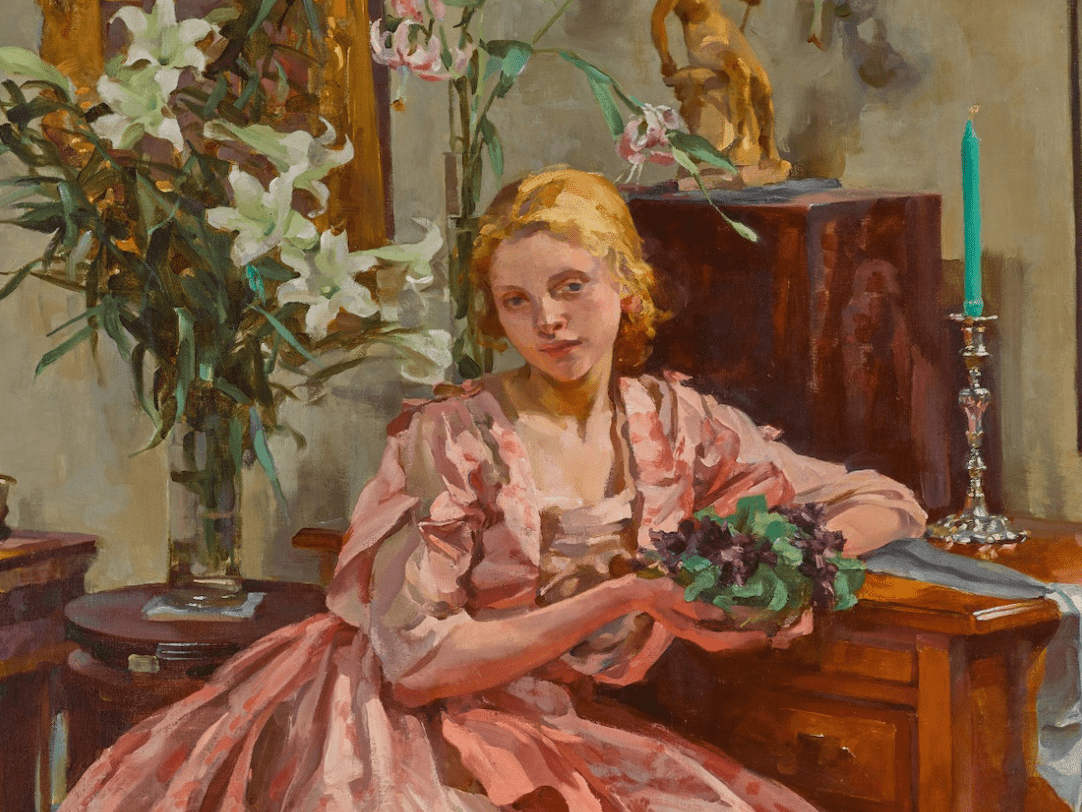
In the Spring of 2022 Skymeadow Gallery acquired Young April. This picture evokes the twin hopes of both spring and youth, more than that, it is a tour de force of her most confident abilities, her capacity to paint light, her love of flowers and interiors and her tenderness towards the human condition.
The importance of Young April as a work that represented Airy’s capacities at their zenith was acknowledged at the time she painted it and resulted in its extensive exhibition history. Young April was shown at The Graves Art Gallery in Sheffield (1934), Walker Art Gallery in Liverpool (1935), Bradford & Huddersfield (1936), Doncaster (1937), Institute of Fine Arts in Glasgow (1938), Bournemouth and Ipswich (1939), and then well into the following decades at the Usher Gallery in Lincoln (1944), R.B.A. Galleries in Suffolk (1952) and at Christchurch Mansion in Ipswich in (1985).
We are also delighted to have a fine water colour by Airy within our collection entitled Embroidery. Airy submitted this work to the Royal Academy Summer exhibition in 1930. Intriguingly it seems to be one of twelve Royal Academy pictures from that year recreated as Tableaux Vivants at the Royal Hall, Harrogate, in July 1930. I am indebted to the fine Airy scholar Alison Thomas for this detail. Both Young April and Embroidery can be viewed at Skymeadow Gallery.
Skymeadow Gallery remains in active discussion with academics, private collections, curators and museum collections to contribute towards the ongoing reevaluation by both the market and our cultural institutions of this important British female artist.